Sustainable Materials in Indian Architecture Never Needed a Global Certification

Updated: 7 days ago
Sustainable materials in Indian architecture didn't need a certified trend to prove themselves — lime plaster, laterite, and terracotta already had, centuries before anyone was writing about it. Every design publication running a 2026 trend piece right now has a version of the same list: FSC-certified wood, bamboo ply, hemp textiles, recycled terrazzo. Genuinely good materials, all of them, and I'm not here to argue otherwise. But I want to point at something these lists consistently skip past — a set of materials India has been building with, sustainably, for centuries, that never needed a certification body to prove it. They just had to survive a few hundred monsoons.
Lime plaster, laterite stone, terracotta. None of them is new. None of them arrived with a sustainability label attached. They earned their place in Indian buildings the old way — by working, in this climate, for this long, without anyone needing to test that claim in a lab.
Lime plaster
Before cement became the default, lime plaster was how India's forts, havelis, and temples were finished — and a meaningful number of them are still standing, still breathing, centuries later. That's not a coincidence. Lime plaster is porous in a way cement isn't, which means it lets moisture pass through a wall instead of trapping it — a genuinely important property in a country where humidity, not cold, is the thing most walls are actually fighting. Trapped moisture behind a cement finish is exactly what causes the damp patches, peeling paint, and fungal growth that show up in so many Indian homes within a few years of a repaint. Lime plaster's breathability avoids a lot of that problem structurally, rather than papering over it with a better sealant.
It also does something cement genuinely can't: it self-heals. Fine hairline cracks in lime plaster slowly recarbonate over time — a chemical process that lets the material knit itself back together at a microscopic level. And it has natural antimicrobial properties that make it inhospitable to the kind of mould and mildew that thrives in a monsoon climate. None of this is marketing language. It's why the material was chosen in the first place, long before anyone was writing trend pieces about sustainability.
In the urban homes and apartments where I've actually used it, the feedback from clients has been remarkably consistent, and it's not the kind of thing people usually volunteer unprompted. They tell me the room feels cooler than the rest of the house — sometimes cooler than their previous home entirely. They mention, often with real relief, that there's none of the sharp chemical smell that comes with a fresh coat of ordinary paint, the kind that usually means keeping windows open and staying out of a room for a few days. And more than once, someone's described the finish itself as looking natural, even rustic, in a way a flat coat of paint never quite manages. None of that is language I'm reaching for to sell the material — it's what people actually living with it tell me, every time.
For sourcing, lime for construction-grade plaster in India typically comes out of Rajasthan and Gujarat, where lime kilns and processing have been established for generations. Worth asking any supplier where their material is actually coming from — "lime-based" gets used loosely enough in the market now that it's not a guarantee of the real thing.

Laterite stone
If you've walked through Bekal Fort in Kerala or St. Angelo Fort in Kannur, you've stood inside laterite. It's a porous, volcanic-origin stone quarried along the Konkan and Kerala coast, and it's been a structural material there for centuries because it does something genuinely clever: it's soft and easy to cut when it's freshly quarried, then hardens on exposure to air. That single property made it a practical building material long before power tools existed, and it still is.
What I love about laterite for a contemporary project is what happens after it's placed. It weathers into a warm, reddish-brown patina that no other stone quite replicates — it looks different at five years than it does on day one, and better, not worse. It's also minimally processed compared to a manufactured material, which keeps its embodied energy low, and its porous structure means it breathes in exactly the way a coastal, humid climate rewards. I use it sparingly — an entrance wall, an accent cladding — precisely because it has enough presence that it doesn't need to cover a whole facade to make its point. Most of what reaches a project outside Kerala or coastal Maharashtra still comes from stone yards along that same Konkan-Kerala belt, which is worth knowing if you're trying to judge whether what you're being sold is the real material or a look-alike quarried somewhere with no real tradition of working it.

Terracotta
Fired clay tile is, by a wide margin, the most widespread traditional roofing material in India — you'll find it from Kerala and coastal Karnataka, up the Konkan, across the Deccan, into Bengal and the North-East. That's not regional coincidence. Terracotta is porous and carries real thermal mass, which means it moderates heat rather than radiating it back into a room the way a metal roof does. The small gaps between overlapping tiles allow a constant, quiet airflow that keeps a structure dry and the rooms below it cooler — a passive cooling system, essentially, that predates the idea of "passive cooling" as a design term by a few hundred years. A well-maintained clay-tiled roof lasts thirty to sixty years, and it's repairable one tile at a time rather than needing to be replaced as a whole system — about as far from disposable as a building material gets.
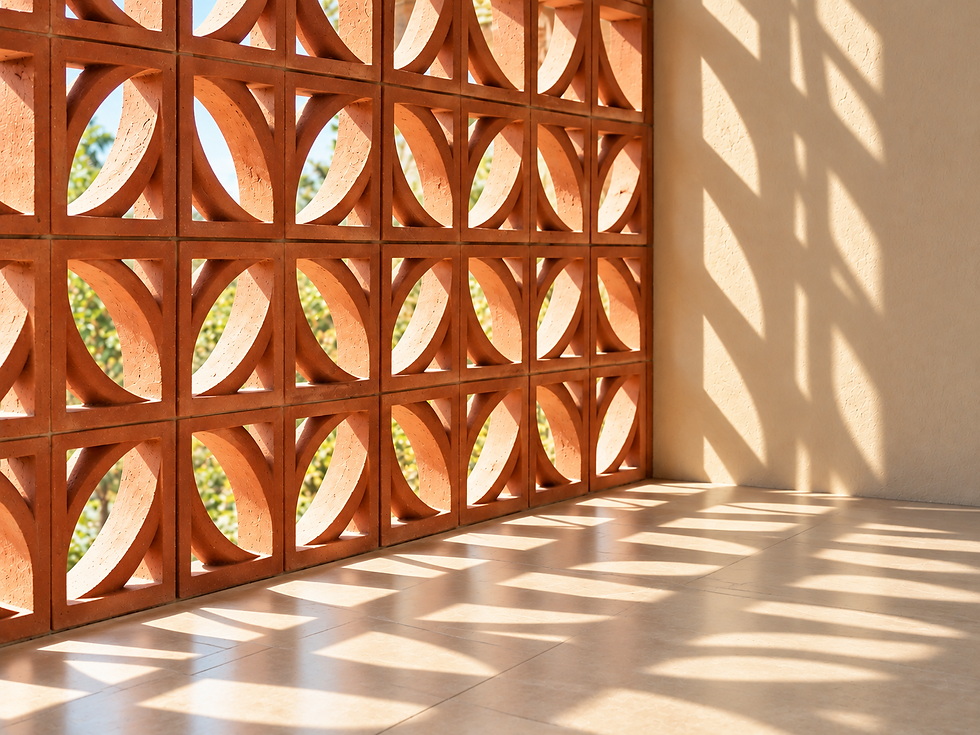
I use terracotta well beyond roofing — flooring, jaali screens, feature walls — for exactly the same reason it was chosen for roofs in the first place: it holds its own in Indian heat without needing anything synthetic layered on top to compensate. For sourcing, two regions do most of the heavy lifting: coastal Karnataka around Mangalore, historically significant enough that the tiles carry the city's name, and the Bankura-Bishnupur belt in West Bengal, better known for terracotta temple craft but a genuine source for tile and detail work as well.
Why this distinction actually matters
I'm not making an anti-import, anti-innovation argument here — bamboo ply and hemp textiles are genuinely useful materials, and I'd use either where they're the right fit. What bothers me is the implicit framing in most sustainability content: that eco-conscious material choice is a new idea design needs to be taught, arriving via a certification stamp from outside. India didn't need an external body to validate lime plaster, laterite, or terracotta as sustainable. Communities figured it out through the much slower, much more rigorous process of a material either holding up against a monsoon and a heatwave, generation after generation, or being abandoned for something that did.
When I specify one of these materials for a client now, I'm not chasing a trend that happens to have found its way back to relevance this year. I'm reaching for something that was already the right answer, that a certification industry simply hadn't gotten around to noticing yet.
Comments